
“A reader lives a thousand lives before he dies, said Jojen. The man who never reads lives only one.”
― George R.R. Martin, A Dance with Dragons
I feel that the majority of people these days take literature for granted. While we definitely are not reading literature as much as we used to as a society, we are reading more than ever because we have access to almost anything imaginable in the palm of our hands. Many continue to endlessly browse social media and the internet for hours on things that aren’t necessarily intellectually stimulating or even worth while. However, I don’t blame a single person for this. We live in an age where this is widely accepted and encouraged almost every where we go. Each technological advancement stems off the last and has created and endless cycle of a technology dependent society (which is definitely not a bad thing but should be taken with caution). We’ve gain this attachment to our phones and our this stimulation of dopamine that our life style relies on this to function and many of us lose grip with reality. How many times have you felt your phone vibrate only to pick it up and see no notification?
These days anyone would rather sit on the couch scrolling on their phone then sit down and quietly read and take in everything a book is trying to tell/show you. It isn’t until you truly appreciate what literature is and how it has and can improve your life until you start to enjoy reading. We have all taken literature for granted through the ease of information, but at some point it may come back to hurt us.
No matter how old you think the Earth is or when humanity first started, billions of humans and animals alike have walked, swam, or flown across the world. Each with their own individual perspective and set of experiences that makes them who or what they are. But these experiences are just a reflection of one singular existence on this planet. An intangible amount of these experience have been lost and forgotten over the years before the first examples of cave drawings and literature began to appear. Although some may say that simple cave drawings or ancient Sumerian cuneiform do not necessarily constitute literature, this was an early form of communication and the first way for another person to walk in their shoes.
Without literature life would only be from your own perspective. From cover to cover, we are able to imagine the unthinkable and share the author’s experiences and take in new perspectives and opinions. Discussion is able to be had and what we regard as humanity is established. I mean how would we know what to know and how to act without a previous recollection of how other’s evolved to act as a functioning society?
But why do we believe the things that we believe?
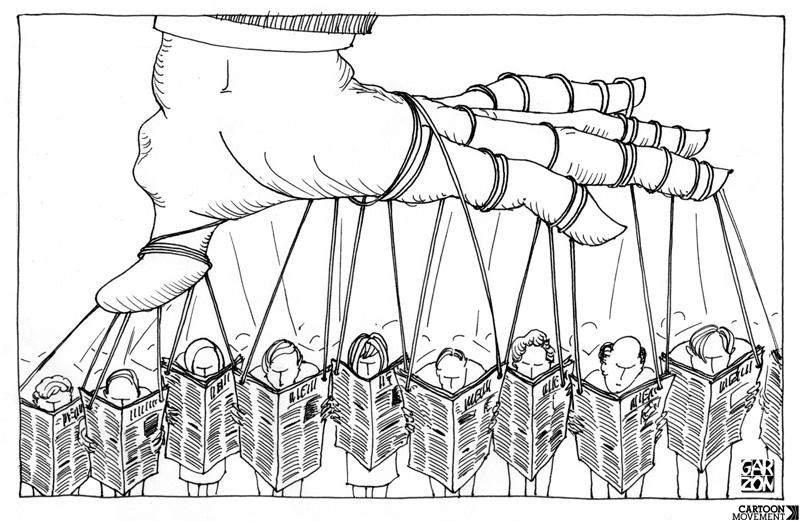
At some point in our lives someone told us something that they insisted was true and we believed them. As a society we can see where this comes into play because there is a vast consensus on whether the sky is blue or not.
“It is the mark of an educated mind to entertain the thought without accepting it”
-Aristotle
When you look at the culture of today, everyone gets their original information on current events from the news. Today, there are five big players that control the media and how it is being put out for their viewers. These five big players have an overwhelming pervasion on our everyday life because they are constantly pushing the same perspectives over and over onto their audience. What Aristotle is saying is extremely relevant to the times. Many of us have all fallen victim at one time or another to reading an article or a headline and believing it right away, no matter if it was written an hour or a month after the event happened and took it to be true. What I have learned to do over the past few years is to always watch both sides and then go look at their primary sources to find the facts. There is always this picking and choosing of information depending on if it helps your message and it’s begun to be a huge problem. We’ve learned everything about our past by reading personal recollections and history books about our past.
When you start thinking about how divided our country and our people are portrayed to be and this picking and choosing and choosing of information, how can we as a society produce a clear record of what is actually happening for future generations to look back on and for us to appropriately react to?
 Mass Media and American Life
I love the quotes you included. It’s so true how reading opens us to new experiences and stimulates us intellectually. Reading a book is much different than reading an article on snapchat or something quick and attention grabbing on our phone. I like how you pointed out how our generation goes for quick fixes instead of seeking to expand our knowledge and deepen our understanding through reading cover to cover books.
LikeLike
I like how you connected the cave drawings as an early form of literature. It saddens me that books are going “out of style” yet our ways of communicating have always been evolving. Although now it is more about knowing what to believe. In the ’80’s, when the news came on, I don’t believe there was the question of, “is this person telling us the truth?” People sat down and watched the news at 6:00 and that was simply what was going on in the world. I feel like now we are on information overload and there isn’t always the time to dissect it and figure out what is real. I don’t have an answer to your question. I don’t know how we will be able to discern what is real, unless we start fact-checking everything including social media posts. Even then, is that an impingement on our freedom of speech? I wonder what will happen to Facebook and Twitter if all posts are fact-checked? I am not entirely opposed if you are sharing an article or scholarly journal or something.
LikeLike