
The internet has been around ever since I can remember, having always been a staple at home and school. I remember playing complex games (with other people), doing homework and sending emails on the computer when I was very young. To me and many millennials with shared experiences the internet we are completely oblivious to when and how it was ever created. During the Coronavirus pandemic it seems as if we can all thank the internet for giving us the ability to continue going to school and our jobs in a virtual format. Also in simpler times, the ability to catch up with friends in family over video services and social media platforms like Facebook and Instagram. As a semi-recent high school graduate living in a different part of the country from my home (and having friends attending universities all over the U.S.), I have come to really appreciate the internet in making it so much easier in maintain these friendships and pursue my degree (mostly) online. I am also applying for (virtual-internships), these are not cancelled because of platforms such as zoom which is great- still allowing me to work towards my career goals in a safe environment isolated from the fear of contracting the virus.
The internet’s development was a process that spanned over 40 years. In the Video “Who Invented the Internet? And Why?” this was made possible by a group of intelligent scientists with the intention of making a useful platform but had no idea would turn into such a major contribution to the day to day life of people all over the world. These scientists ranged from The U.S., Britain, Switzerland and France.
A popular yet incorrect theory about why the internet was created is that an American security team invented the internet to have an ongoing communication method that could survive a cold war.

The internet came into fruition during the late 1960’s with the help of MIT’s J.C.R Licklider’s and his idea of an ‘intergalactic network. Computer scientists worked on a concept known as “packet switching” which was the transmission of electric data. This method was able to increase the pace on busy networks by splitting up the data being processed and then re-assembling it on the other end. On August 6th, 1991 the web (part of the world wide web) became available to the public thanks to its founder, Timothy Berner’s Lee. His first website was created in Cern, France in August of 1991.
This updated version of the internet contributed to the creation of ARPANET which was a newer method requiring the use of packet switching, giving communication access to a multitude of computers sharing a single network.
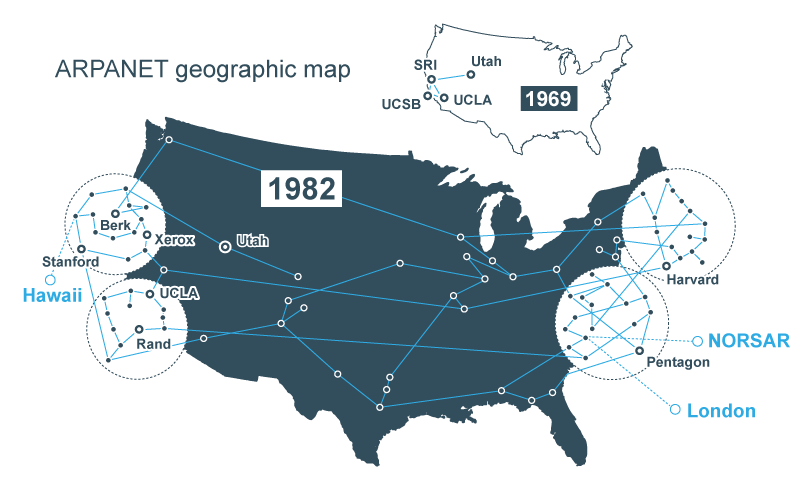
Once the internet ‘basics’ were established, people found new and interesting ways to use the internet involving other people and creating communities. Internet message boards became extremely popular during the 1980’s and are still widely used today. Telephone companies saw the array of possibility in using digital communication and different web browsers were discovered and used. Believe it or not, email was ALSO one of these things that only become popular of use during this period which I personally found to be unbelievable. It’s hard to picture what life was like before the internet and everything that came along with it.
My question for the class is; Do you think humanity would find an alternative way to function if the internet shut down (temporarily or permanently)?
Do you think this would change the way we live for the better or worse?













 Mass Media and American Life