Author Archives: Pablo Prunty-Russo

The Amazing History of TV

Most people know who invented the car and the airplane, but how many people know who invented the TV?  Yet, according to google most Americans spend approximately 4 hours in front of the TV a day and they spend far less time in a car or on an airplane.

Entertainment Center Selection: TVs, Soundbars and Streaming Devices -  NewHomeSource
family watching tv

 Perhaps people don’t know who discovered TV since it turns out the TV was not invented by one or two people, but by many individuals. TV started with the German physicist Karl Ferdinand Braun who invented the cathode ray tube in 1897.  It was later that German inventor Paul Nipkow created the scanning disk. Later, in 1907, Russian scientist Boris Rosing combined those two discoveries in an experimental television system.
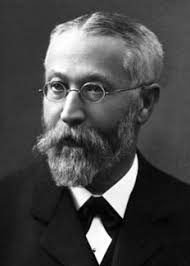
Ferdinand Braun - Biographical - NobelPrize.org

Mechanical television was later developed by British inventor John Logie Baird. At the same time and separately Charles Jenkins was working on an electronic television system based on the cathode ray tube. An Idaho teenager by the name Philo Farnsworth realized that the electronic beam could scan a picture in horizontal lines reproducing the image almost instantly.  Presto the TV was invented.

Philco Predicta Siesta Table Model With Floor Stand Antique Vintage Television  Set TV
first tv

Remarkably, the first TVs were as small as 5-inches and as large as 12-inches.  Compare that to the 80-inch or larger TVs of today!

TVs became available in 1950s and took off in 1955. During this time shows, a couple of which still exist such as the Today Show and the Tonight Show. Others have come and gone but remain with us, such as my favorite I Love Lucy. Initially TV shows were 15 minutes in length and grew to 30 minutes. Television then and  now reflects cultural standards and also influences cultural. Language on TV is regulated by the Federal Trade Commission. Networks had sponsorship initially from a single sponsor but later from multiple sponsors. Advertisers brought one to two-minute spots on a show. It is interesting to note that public television, which was paid for by the government, was initially for people in rural areas who could not afford to pay for a private television service. Now adays PBS receives very little government funding. However, in the UK the BBC has been and remains financed by the British government. Other countries, such as France, have similar government funding.

PBS - Wikipedia
PBS Logo

   Between 1959 and 1964 the popular and engrossing Twilight Zone was broadcast. Rod Serling the writer and star of the show. Serling wrote stories about the common man with adages examining themes such as “Be careful of what you wish for” and around punishment or comeuppance such as having people where mask showing their true feeling that cannot be removed. It was a creepy, surreal, and highly engaging show. Rod Serling not only created a great show but he  forced people to think about the repercussion of their behavior. Its impact led to other similar type shows but none could replicate The Twilight Zone. This was the first time a television writer became a celebrity.

The Twilight Zone (1959 TV series) - Wikipedia
Twilight Zone

The sixties also brought about bringing news into your living room. We saw the first man orbit the globe, the assassination of JFK, the Vietnam War, and the man on the moon. TV began to change policy and the killings in Vietnam made people question why we were there. The sixties also brought about the first satellite television signal but, it was not until the 1970s that we began utilizing satellites for broadcasting purposes.

How to do satellite dish Installation and Setting up receiver
Satellite

The 1980s brought about the explosion of cable TV this led to a sudden increase in news and entertainment channels. In the 1990s and 2000s networks became more specialized catering niche markets in order to meet the needs of a diverse and fragmented audience.

It was the 21st Century that brought about digital TV. Again, TV changed radically. Outlets such as YouTube could broadcast whatever they wanted. The 16-year-old with no script, producer, or director could have his own TV show and suddenly become a celebrity.  Other outlets such as Netflix were able to move beyond the mailing of CDs to producing their own content. All of a sudden anyone could be a producer and develop a wide audience, and content could be viewed on one’s phone. This is the TV we know today.
How the 20th Century Changed Communications

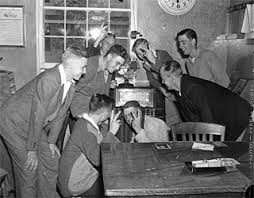
The 20th Century was responsible for a lot of things, but with media it started with the radio. The first commercial radio station was established in 1920. When you think about families huddled around the radio listening to music, a radio play such as the one we saw in Frasier or a comedy show, it brings warm feelings to think about a family time listening to that radio instead of a group of people sitting the at the dinner table with devices in hand. Everyone is in their own little word and no one is talking or laughing together.

Group gathered around office radio, VJ Day, 1945. | Minnesota Historical  Society
family huddled around a radio

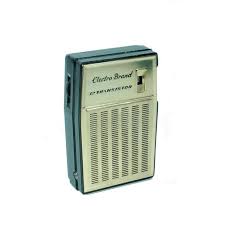
The post war prevalence of radio hugely impacted popular music. Radio airplay of popular songs helped promote record sales. The thirties saw the rise of jazz and blues, vaudeville and ragtime. Rhythm and blues laid the groundwork for rock and roll. Popular music diversified in the 1960s and brought about folk and soul music. Ten years later we had disco and punk. Hip-hop dominated the 1980s and pop became successful in the 90’s and 2000’s. In a period of 80 years over a dozen music genres emerged largely thanks to the radio. That radio evolved from a small box that you plug into the wall to a transistor that you carry around. It further evolved into multiple bands such AM and FM were there are more specialized stations then later to satellite radio where one can find increasingly specialized stations where one can listen to information about one’s sport team or one singer such as Frank Sinatra.

Vintage Electro Brand 12 Transistor Radio Gold and Black
Transistor radio

The radio pushed music into the forefront of world culture. Whole industries began to form around music. There was a relationship between culture and music with music influencing youth culture, migration and racial integration. Record labels began to form and records evolved from 78s to 45s to LPs and from vinyl to tape. Bands and singers became successful overnight and made hundreds of millions of dollars.

This all came tumbling down with the creation of Napster.

RCA Victor Phonograph

With the advent of the computer and the ability to digitize music, people could swap music from one hard drive or MP3s to another hard drive thus by passing the record company and copyright laws. Eighteen year old Sean Fanning changed the world with his discovery of Napster, a pioneering peer-to-peer file sharing internet software that utilized digital audio files. With this discovery, he threatened to bring the music industry to it’s heels. This now multi-billion dollar industry was not about to let some 18 year old pull the rug out from under them. Lawsuit after lawsuit was filed and copyright lawyers had a field day. How they asked can Napster bypass the copyright laws? The company that was changing how we listen to music in two short years would be dead. Though the sharing of music through audio songs encoded in MP3 format was not permissible, the digitization of music allowed for a revolution in the music industry leading to new forms of purchasing music such as through iTunes or listening to whatever one wanted listen to with Pandora or Spotify.

How the music industry shifted from Napster to Spotify — Quartz
The "Ultimate" Driving Music Service is Now Powered by Napster

In short 80 years it is remarkable to think about the revolution that happened in music. Today we walk around with are airpods stuck in our ears listening to music throughout the day whether it’s doing our homework or eating are dinner. It is hard to imagine a family huddled around the radio waiting for their favorite program or music show. It is also hard to imagine where music would be without the radio or the ability to digitize the songs. Music is such an integral part of our lives — it influences so many aspects of our culture — and the ability to listen to any song you want at any time of day would likely not happen without the discoveries of radio and Napster.

Are Newspapers an Artifact of the 20th Century?

Newspapers have had a glorious history. From Gutenberg’s movable type, which lead to the printing press, to the uncovering of the Watergate burglary that led to resignation of President Nixon, and from Benjamin Day’s penny newspaper, The Sun, to digital media, newspapers have played an important role in how we think.

Some people say that newspapers are dinosaurs. How many people actually read newspapers? People watch the news on TV and they read it on their computers and smartphones, but the days of newspapers are dwindling. Circulation is decreasing. Newspapers like USA Today, with it’s TV like presentation of news, have become among the highest circulating newspapers today. But even USA Today is increasingly moving to an online format. My family still subscribes to a newspaper, but when it didn’t arrive one Sunday morning my father went to the local store to purchase a newspaper and found out they no longer sold newspapers and the nearest store that sold them was ten blocks away.

We learned in our readings that newspapers have existed since Roman times, but the modern newspaper exists primarily from Gutenberg press German papers printed in the 1600s. But it was Benjamin Day who brought newspapers to the masses by having them cost only a penny so that more citizens could afford a newspaper. This is when media became mass media.

The 1800’s welcomed newspaper men like Joseph Pulitzer and William Randolph Hearst. To compete with one another the two used sensationalism and crime, sex, and scandal became the news of the day. Yellow Journalism as it was called, printed misleading stories exaggeration and misinformation. Today, this would be called fake news.

During this era, cartoon newspapers, such as The Yellow Kid were prominent since they were easier for Immigrants to read and understand. Other types of Journalisms evolved such as literary which combined research and reporting with the writing style of fiction. We see this type of work today in publications such as the New Yorker and written by prominent writers such as Tom Wolfe, and Truman Capote. Other styles such as advocacy journalism, consensus journalism, and conflict journalism also evolved which lead to niche newspapers. Today, this is been further dissected with the advent of blogs and extremely narrowly focused online publications.

Within newspapers there evolved columns or sections of the newspaper that focused on issues that were either ignored or not fully investigated. The film Spotlight focuses on the Spotlight team at the former Hearst newspaper, The Boston Globe and there investigation of sexual abuse by the Boston’s Catholic priests. The team spent eight months digging into the roll of the Boston archdiocese in covering up the sexual abuse of children by priests. It is a chilling study of the way power operates in the absence of accountability. The movie is a gripping detective story of group of journalist who gradually uncovered the crimes by 249 priest and brothers. Rather than stop at one or two they saw a house of cards which could not be written about until all the cards have fallen.

It is movies like this that underscore the the importance of newspaper. Papers like The Globe take the time to do the research to uncover the facts that lead to change. We see this in the New York Times, Wall Street Journal, Washington Post and other newspapers. They write stories that can and often do change the world.

So, are newspapers an artifact of the 20th century? Probably the paper is an artifact since printing is expensive, but the style and approach that newspapers and news magazines take will be with us for centuries to come — it will just be online.

History of Books

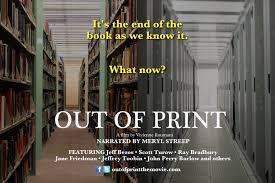
Out of Print' Doc Examines The End of Print Books and What It Portends
Out of Print

Out of Print covered the history of books from the earliest days, from cave drawings to electronic books. The first libraries were in Egypt. The largest is in London. Discussed were the printing press and movable type, scrolls, illuminated manuscripts, paper books and e-books.

Torah scroll that women helped write to be unveiled in Madrid | The Times  of Israel
A scroll

The history of books covered the same territory only in greater depth. Cases were made that our society is becoming increasingly illiterate. With smartphones people are reading chunks of information. People are reading summaries of books rather than the books themselves. People are not thinking about what authors are writing and are not learning by studying is saying rather they are taking the information condensed by others.

Out of Print discussed issues around electronic books. Organizations such as google and others are copying books too make them more widely accessible. However, some people are concerned that they may try and use the information for advertisements and other ways to monetize the books.

A e-book

One of the points I never thought about was the fact that paper books have been around for centuries and will continue for centuries. E-books are ephemeral. A book that someone self publishes might be lost over time. Also, with the advent of e-books, authors must not only write the book, but they must edit it, create the artwork for the book jacket and summarize the books content. They must also market their book.

Free stock photo of catholic, font, gothic
The first books

Writing changed the world, but it was paper that allowed people to circulate their story’s and thoughts. With e-books the world is flat. Anyone can write a book and have it read around the world. You don’t need an agent, you don’t need a publisher. Amazon through its algorithms can greatly impact how people learn about books. If I by Tom Clancy I might also be asked if I’m interested in a book by David Baldacci. If I liked horror books I undoubtedly will be led to Stephen King. This is the power of Amazon.

I live in New York and I am about five blocks from Strand Bookstore, which is prominently featured in Out of Print. It is the last book store of it’s kind. When I walk into that store I marvel at the sheer number of books. It seems one can find almost anything there. This store has been there for decades. It was once THE place to find a book. It would be sad if we lost Strand Books forever.

Strand Bookstore - Wikipedia
Strand Bookstore

Introduction to communications class

Hi, my name is Pablo. I am a sophomore studying communications. I recently transferred my major to communications. My dad is in the communications business and runs a PR firm. He is also a graduate of AU.

I grew up in New York City. In the East Village area.

I recently went from being a major baseball fan to a major UFC fan. I also like football and hockey. I love to travel and I am fortunate enough to have traveled to five continents. I am very much looking forward to this class.