Author Archives: nataliernorris20

The Purpose of Television

TVs can be found anywhere–including restaurants

You’re sitting at the dentist’s office or eating a double cheeseburger at Burger King or pumping gas into your car—and what do you see?  Boom.  It’s a screen.  Another one.  Almost everywhere you look, you can find a TV.  Television has saturated the culture, and it has not even been around for that long.  In many ways, television has expanded ideas and been used as a tool to educate people and inform them about current events in the world.  It has acted as an entertainment device, bringing family and friends together with the most recent episode of whatever the popular show is at the moment. Because television is so prevalent and holds a lot of power over society, it helps to understand it and to ask the question, what is the purpose of television?

               Understanding Media and Culture says that ideas for the television sprouted as early as 1876 (350).  Then, “In 1907, Russian scientist Boris Rosing used both the CRT and the mechanical scanner system in an experimental television system” (350-351).  Interestingly enough, even though now almost everyone has access to a TV, it used to be that only the rich could afford to have a TV (353).  During World War II however, the technology to be able to mass produce things was developed, and after the war, that technology was applied to the production of TVs, making them much more affordable to the average person (354).  Television slowly, bit by bit, replaced the spot that radio used to hold.

Mass production of tanks during WWII. Mass production technology was applied to the making of televisions.

               When television started gaining popularity, a decision had to be made—what was it going to be used for?  The United States decided to take it in the direction of commercial broadcasting with NBC and CBS (352-353).  Some people wanted more out of television than for it to be just entertainment.  The documentary, Rod Sterling: Submitted for Your Approval, brings up this point by telling about the life and career of Rod Sterling, an early and famous television writer.
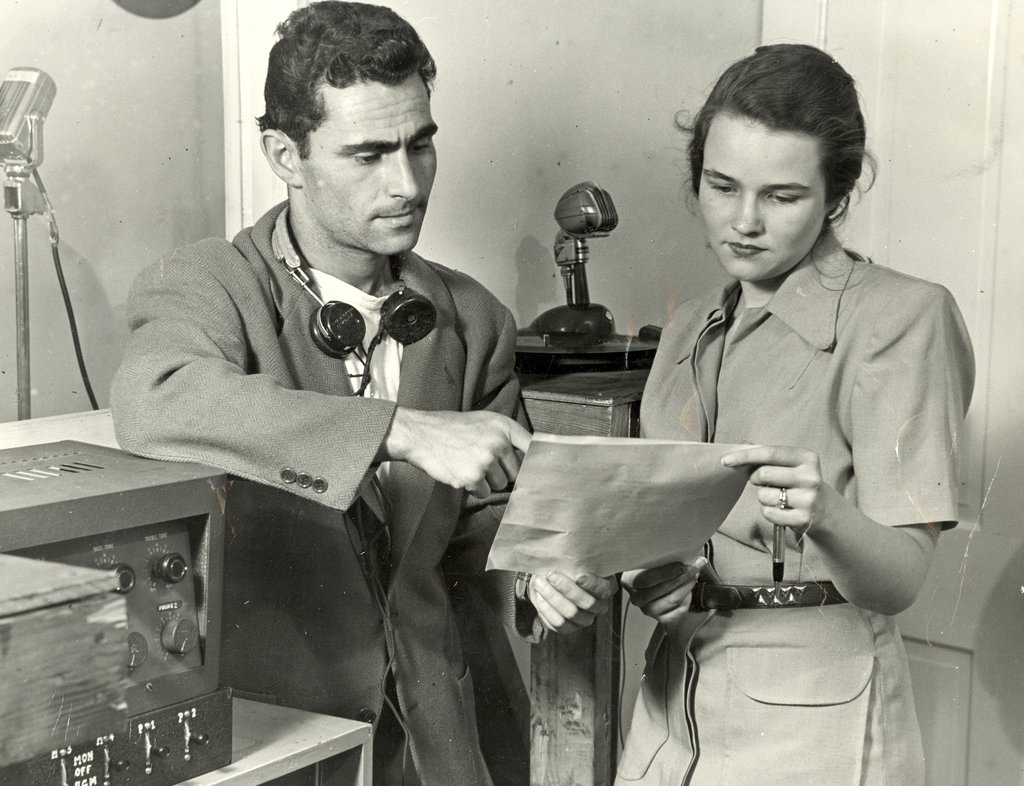
Rod Sterling and his wife, Carol Sterling

               Rod Sterling is probably most well known for his writing of The Twilight Zone, but he originally started his career by writing live television dramas, which brought the theater to television (Rod Sterling: Submitted for Your Approval).  Rod wanted to write things that had social impact—that made a difference in lives.  His wife, Carol Sterling in the documentary says that “He felt that television had a responsibility to not only educate and entertain, but to illuminate the social conditions” (Rod Sterling: Submitted for Your Approval).  Rod knew that television had power and that it had a purpose.  He used his influence to write “morality tales” to get people thinking and to make TV more than just a way for the sponsors to make more money

25th June 1962: American television writer and producer Rod Serling, his wife, Carol, their daughters, Jodi (L) and Nan, and their golden retriever, Beau, sit in a lounge after arriving from Los Angeles, LaGuardia Airport, New York City. He has a TWA duffel bag beside him on the seat. (Photo by Hulton Archive/Getty Images)

Understanding Media and Culture reminds that “The symbiotic nature of television and culture is exemplified in every broadcast, from family sitcoms to serious news reports” (360).  It’s important to recognize that what is on TV will impact the culture and vice versa.  Rod Sterling know this, and we are left to ask ourselves the questions: What can we do to influence what is on television?  How can we become more aware of the impact of television in our lives?  What is television’s purpose, and is it fulfilling that purpose?
Music: A Bonding Force and the Issue of Digitization

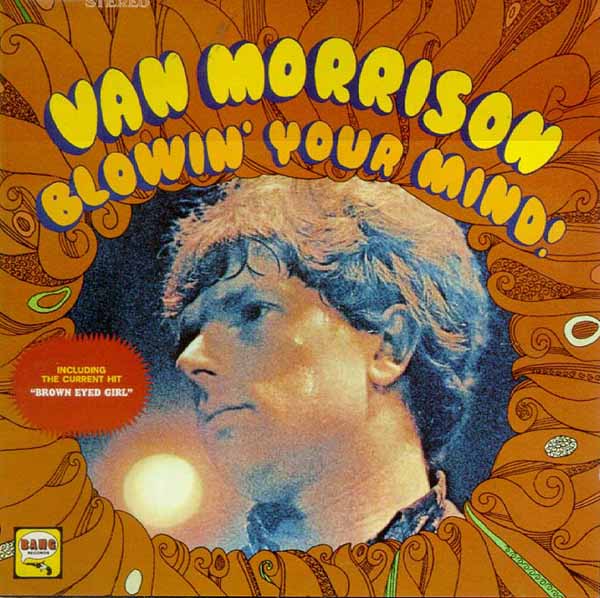
Brown Eyed Girl: A poplar song of the ages

My fingers pluck the strings of my ukulele, and the popular Van Morrison song floats out.

“That’s “Brown Eyed Girl,” my middle-aged neighbor comments as recognition crosses his face.

               “Yep,” I smile. “We were listening to the Oldies station at work, and I thought this one would be a good one for my uke.”

               “The Oldies station?  Man—70s and 80s songs being on the Oldies station.  That’s crazy.”

               This conversation I had with my neighbor helps to demonstrate the fact that music spans time, ages, and cultures.  Music is magic.  You can listen to a song over and over and it does not get old, and I can enjoy the same music that my neighbor did when he was a kid.  Understanding Media and Culture goes through the history of music in Chapter 6.  Along with different genres of music is how it has morphed in the way it has expanded to people.  Again, the reason for this change, like with most forms of mass media, is due to the introduction of technology.  Digitizing music completely changed the game.  The question becomes then, how does one make music easily accessible to the public but also allow for the artists and music industry to make a living?  How do artists combat piracy when it is so common?

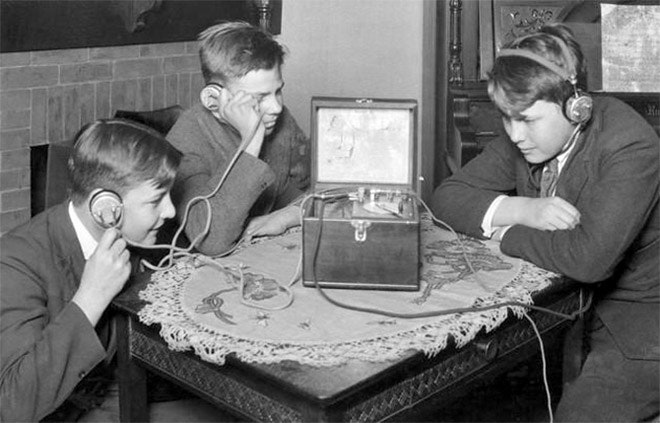
Boys listening to the radio in the 1920s

               Understanding Media and Culture says that, “In 1877, Edison discovered that sound could be reproduced using a strip of tinfoil wrapped around a rotating metal cylinder…” (214).  His invention led to the gramophone, “which used flat discs to record sound” (214).  Eventually, radio was developed.  The textbook says that, “Radio was an affordable medium that enabled listeners to experience events as they took place… This development was a threat to the entire recording industry, which began to campaign for, and was ultimately granted, the right to collect license fees from broadcasters” (216).

               The introduction of radio is where we first see this idea of “free” music, and if you fast forward several decades, the same sort of problem occurred with the introduction of Napster.  The documentary, Downloaded, tells the story of Napster.  Basically, Napster was the inspiration for the streaming sites of today, and it made it so that people should get online and share whatever music they had with their friends, and they could download whatever they wanted.   Unfortunately, it led to a lot of pirating of music.  Though some artists were boosted in popularity by people being able to listen to their songs for free, other established bands were losing a ton of money because of it.  Chris Blackwell says in Downloaded that, “This is the first time technology actually attacked the existing system and started to take it away.” Napster had to go to court, and even though the company was shut down, it inspired streaming sites like Apple Music and Spotify who have the same concept as Napster, but they are able to do everything legally and artists still get paid for their work.

Teens listening to music

               Everyone agrees that music is meant to be shared and enjoyed by all, but the question is, how can we do that in a way that benefits all involved—the artists, the music industry, and the public?  What can citizens do to encourage artists in making music, and how can we discourage piracy?

Me playing my ukulele

Standards and Survival

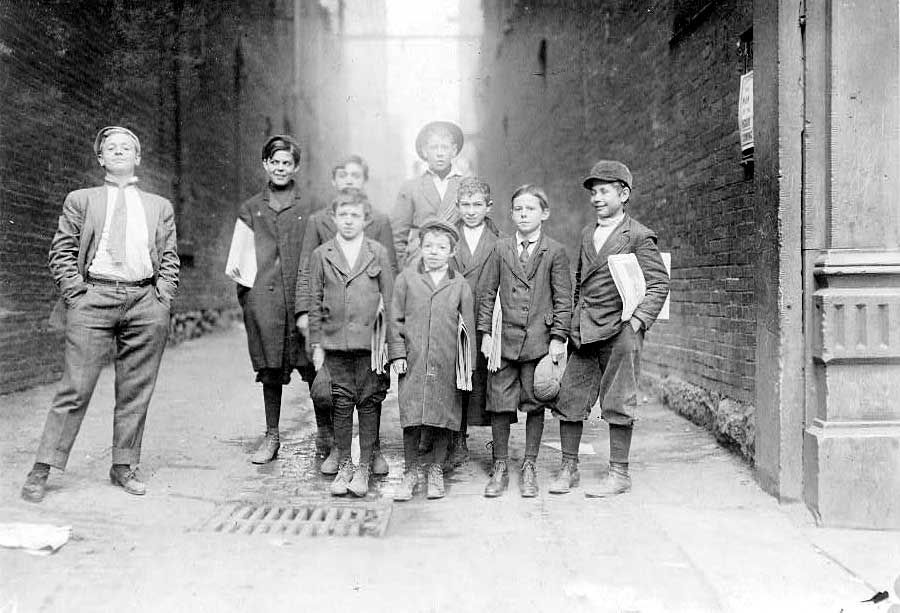
Some Newsboys of history

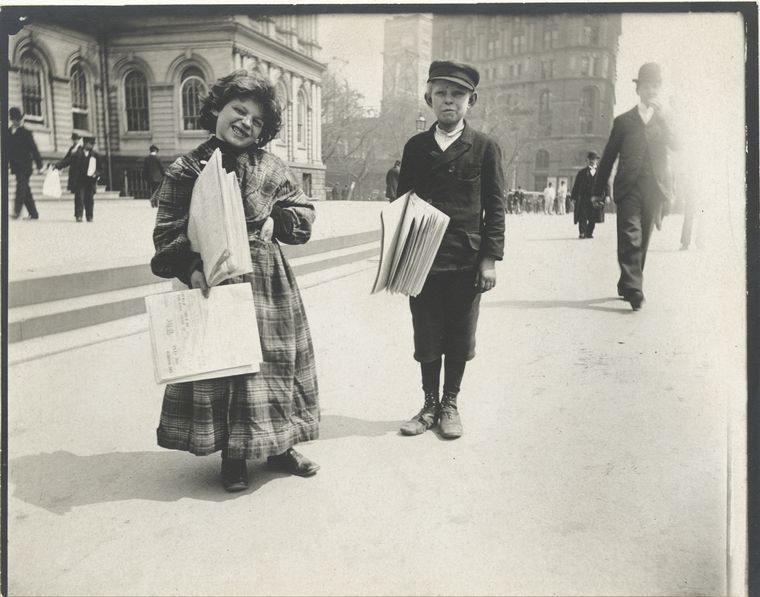
“Extra!  Extra!  Read all about it!” the little boy on the street corner shouts.  It is 1899, and in his waving hand is a copy of the New York World, published by Joseph Pulitzer.  The juicy headline beckons those walking by to stop and pick up their own copy from the boy.  The boy smiles as the paper exchanges between his hands and the young woman’s.  The more scandalous the headline—the more copies he sells.  It’s going to be a good day.

The textbook, Understanding Media and Culture, talks about the subject of newspapers in chapter 4.  Newspapers have been around for quite a long time with the first weekly newspaper using Gutenberg’s press being printed in 1609 (Understanding Media and Culture, 131).  Newspapers, like books and other printed materials, have evolved, and like most evolution, it is not always a good thing.  Through the years of experimenting with how newspapers are written and what articles are found within, one can see the highs and lows of the newspaper business.  Always connecting with the content in the newspaper is the subject of money.  What articles make the most money?  Should making the most possible money be the goal of a newspaper?  How far is too far with “scandalous” articles?  Where does important news fit in?  Can articles that portray the truth and important issues also be profitable financially?

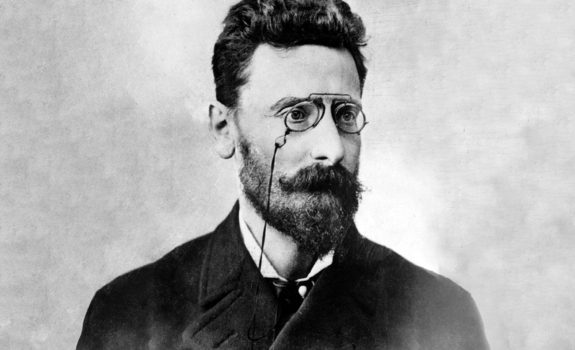
Joseph Pulitzer the inventor of sensationalism

Through laws like the First Amendment in the United States, newspapers have had the freedom to write about important issues and not be worried about being prohibited by the government for what they wrote (Understanding Media and Culture, 135-136).  Unfortunately, some publishers took advantage of this freedom, and they realized that to make the most money, they had to write articles with bold headlines that may or may not be very accurate.  Understanding Media and Culture says that, “In the late 1800s, New York World publisher Joseph Pulitzer developed a new journalistic style that relied on an intensified use of sensationalism—stories focused on crime, violence, emotion, and sex” (138).  “Sensationalisim” is still a tactic used to today, and it demonstrates how newspapers have adapted to make money and survive.

Children selling papers in the late 1800s

Sadly, newspapers are downsizing and cutting off workers because people just do not read them anymore.  Part of this is because of the introduction of the internet.  The TV show, The Wire, in a short clip on YouTube demonstrates this in the words, “It’s a bad time for newspapers.”  Newspapers need to make money to survive, so again, this could lead to less important and less accurate articles.  In the article, “The Guy Who Wouldn’t Write a Hit: An Interview with David Simon” by Claudia Dreifus, David Simon talks about leaving The Baltimore Sun because its quality was going down.  Simon made a tough choice, but that is what people need to do for the truth to continue to be told.  John Oliver on Last Week Tonight also brings up this balance of expansion and the danger of just going after what is popular when he says, “It is clearly smart for newspapers to expand online, but the danger in doing that is the temptation to gravitate toward whatever gets the most clicks.”

So again, the question remains: How does a newspaper balance the need to survive with the need to write important articles that may not be as popular?  Should it be the publisher to make this choice?  How much of a change can individual journalists make?  As a consumer of media, what media choices can one make to help the newspaper industry both financially and in its content?

Christianity and Print

The textbook, Understanding Media and Culture, in chapter 3 gives a history of how the books that we all know and love came to be, from the ancient beginnings of papyrus scrolls to the E-books downloaded on almost every tablet in the world.  What is interesting however is that one specific movement that has changed millions of lives can be tracked along with the evolution of print.  The Christianity movement has grown greatly since it began, and the written word of the Bible seems to be connected.  The question is, did the spread of Christianity and the drive of Christians lead to the developments in print, or did the rise of printed materials lead to the spreading of Christianity?  In addition, has the continual development of technology, and therefore the cheap introduction of any genre imaginable, taken away from various developments of religions and the desire of individuals to immerse themselves in religious texts?

Some Scrolls

               Understanding Media and Culture and the documentary, Out of Print, both spend a little time on the history of books, and both of them begin with talking about scrolls.  Out of Print points out that people realized that to get to the end of a passage, one had to unroll the entire scroll.  The specific scroll in the video was one that was about Christ’s life.  To avoid this hassle came the idea of the codex, which was especially helpful in the spread of Christianity.  “Between the 2nd and 4th centuries, the Romans began sewing folded sheets of papyrus or parchment together, and binding them between wooden covers…The codex was the preferred form for early Christian texts, and the spread of Christianity eventually brought about the dominance of the codex; by the 6th century CE, it had almost entirely replaced the scroll” (Understanding Media and Culture 84-85).  Faith and religion was very important during that time—so much so that in the Middle Ages, monks laboriously copied by hand many classical texts—both religious and secular; they thought that studying even secular works could bring someone to God (Understanding Media and Culture 86).

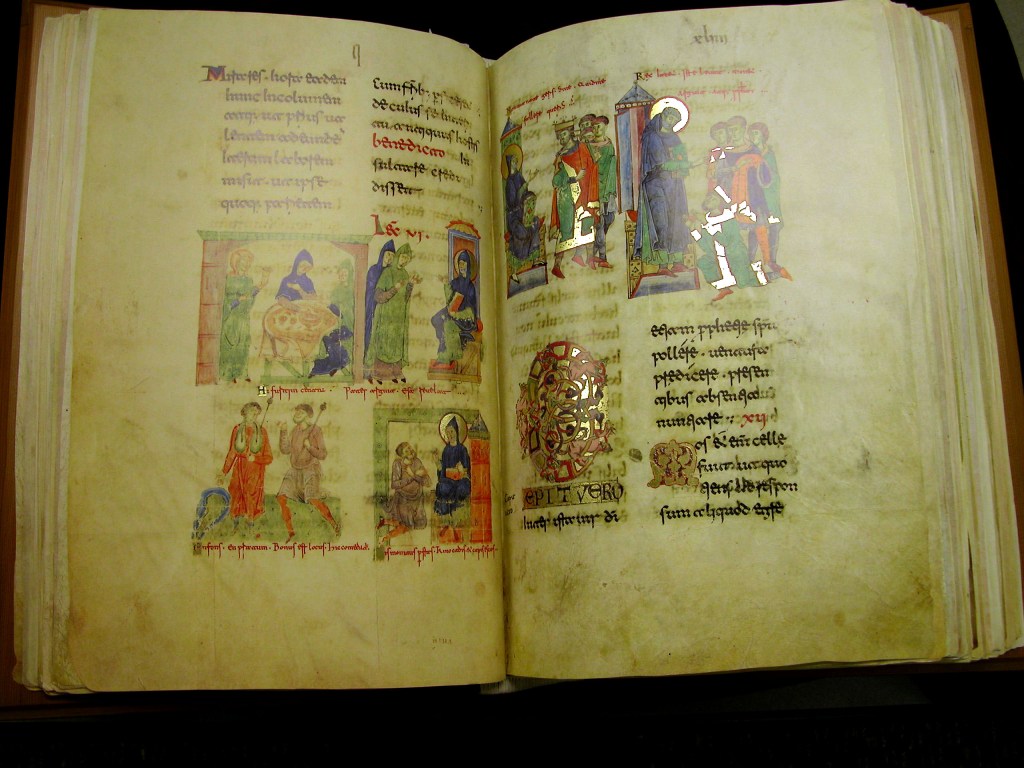
Illuminated Medieval Manuscript

               From there technology developed with Gutenberg’s invention of the printing press.  And what was one of the first things that he printed?  The Bible (Understanding Media and Culture 86)!  Professor Ugo Rozzo in the documentary, Out of Print, says about Gutenberg’s invention that, “It was not an invention of a cultural nature…we know that the printing press is responsible for the spread of the Reformation…”  Though Gutenberg chose the Bible as his great work, the printing press was soon used to print all sorts of things.  Books were so available that they lost value (Understanding Media and Culture 88). 

Fragment of Gutenberg Bible

The textbook and the documentary both go on to tell about the development of technology all the way to today, and therefore, the options that people have for reading are endless.  Unlike it may have been in the Middle Ages, one does not only have religious texts to choose from anymore.  I propose that perhaps people have stopped seeing the value of the Bible and other texts like it because they are produced like everything else and there are so many other things to read.  There is no real cost anymore for reading materials; we do not have monks hand copying the most important texts anymore.  Ultimately, it is nice to have the choice to read whatever you want to, but the question is because this is the case, are people not as interested in the spiritual realm as they used to be?  Is the development of the technology of reading and books related to the decrease we see in the practicing of religions in America?