
Sidney Lumet’s, 12 Angry Men was one of his earliest and perhaps one of his greatest films. The film takes place inside a jurors’ room at the New York County Courthouse in lower Manhattan. When we first meet the jurors they are about to take a vote on the guilt or innocence of an 18 year-old who had murdered his father. We are told that all 12 jurors must agree on a verdict, otherwise it would be a hung jury. A guilty verdict would lead to the boy being sent to the electric chair.
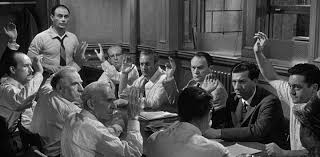
When we meet the juror played by Henry Fonda, we see him from the back and staring out the window. We know that this is the character that will be the protagonist that he will change the course of the events in the room. When the vote is first taken, eleven jurors vote for conviction and juror number eight, Henry Fonda votes against conviction on the basis of reasonable doubt, forcing jurors to question their decision and values.
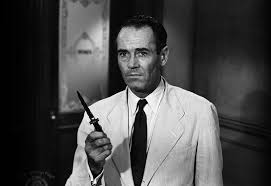
We spend the next hour and 20 minutes listening to the Jurors one by one discussing the crime. Fonda questions the testimony given during the trial by two witnesses. One by one jurors move from being certain of the teenagers guilt to having doubts. Throughout the film votes are taken on the guilt or innocence and the jurors gradually change their votes. The last character to change his mind was juror number 3 who was played by Lee J. Cobb. This juror had a son age 16 who he had decided to toughen up after his son had not fought back during a school fight. An altercation when the son was older led to the dad getting punched in the jaw, which resulted in the son no longer talking to his father. The parallels between the verdict and juror number three have clearly biased his judgement.
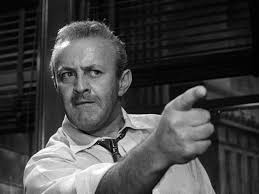
Just as juror number three is forced to evaluate his own actions so too are we the audience forced to examine our own self-image, personality and experiences relative to the question to guilt or innocence. Though it seems unfathomable at the start of the film that one person could change the opinion of eleven, it is indeed the power of that one person to change each other’s decisions and moves the entire room to question their group decision.
I enjoyed this film and the many films and readings throughout the semester. The lectures were stimulating and assignments were helpful in analyzing the content that was presented in class. There was a lot of ground covered in this one short semester. I could see wanting to take more in depth classes on several of the others in class. It is a monster of a class, however it gave me an appreciation of the many aspects and issues surrounding mass media. I spend my day on mass media in one form or another. I believe this class has given me insights into how and why that happens and what it all means. It also gives me an appreciation of the evolution of mass media and its impact in the world in which we live.
Thank you Professor Schlegel for these learnings.
 Mass Media and American Life