
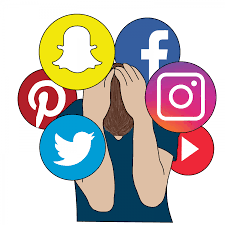
In week 8 we talked about the effects of social media on our society and how it has fundamentally changed how our society is run. Social media today plays a pivotal part on how we connect with people on a wider scale than ever seen before in history. We can talk to someone on the other side of the world in a literal second of our time. This connection between people has allowed us to feel more understanding of peoples cultures, ideas, and identities. But in the midst of global pandemic with riots and protests beings seen around the world some would say that we have lost touch with our morality and that social media is playing a larger part to divide us rather than connect us as was social media platforms purposes. I believe social media platforms have gotten exposed for their usage of algorithms to predict what people would want to see or the friends the algorithm thinks they should add. When social media platforms do this they polarize and radicalize people to certain beliefs that they themselves do not notice. Therefore I think social media has become a unhelpful source in peoples daily lives unless its used in the right way to create more understanding.
We see it all to regularly that people are consumed with how they take information and can be trapped in the same area of the social network not being exposed different ideas and cultures. This is especially true when people feel like they are in the minority and will choose to not speak their minds because of the difference in population that have the ideas in question “Facebook and Twitter users were also less likely to share their opinions in many face-to-face settings. This was especially true if they did not feel that their Facebook friends or Twitter followers agreed with their point of view”(Social Media Spiral of Silence, Keith N. Hampton, Lee Rainie, Weixu Lu, Maria Dwyer, Inyoung Shin,Kristen Purcell, August 26, 2014, Pg. 4) . Not allowing people to have a comfortable place to voice their opinion without fear of being made fun of or brutalized with attacks is something social media platforms have continued to lack.

We can also see how social media platforms try to cater us to certain products that we might like. This can be good in certain situations that we might find objects that we would want. But we can see how using such algorithms to predict products we might like is in fact still a part of our social problem of being trapped in a cycle only things recognizable to us. This can be anything from the color of a T-shirt we want to the sizes of T-shirt to what is said on the T-shirt. It personally perplexes myself when I’m talking about a product out in the open then I see a ad for the same or similar product the next time I’m on a social media site. This goes past trying to help out the individual in situations it is clear how these social media sites are trying to make as much money as possible while taking advantage of the usage of phones and technology in general.
With the social media model that has been shown there’s a dilemma at the core of social media business that counter acts it. A social media platform can either keep advertising the same kind of social groups and products that allows people to find things similar to the person. But doing so it risks radicalizing the person due to only being subject to the same kind of social network. Social media platforms could also let people experience different ideas, people, and products that might be very different to who they are as a person. Doing this would allow for better personal connection with people of different areas of society. The downside to this is that the algorithm does somewhat help with getting people to see products that they might like and potentially become a sale of said products. This is a hard choice for businesses as a whole to make because the point of a capitalist economic system is to make as much value as possible. But doing so could allow for side effects such as the spiral of silence. “We’re the real culprits. When it comes to elevating one perspective above all others and herding people into culturally and ideologically inflexible tribes, nothing that Facebook does to us comes close to what we do to ourselves”(How Facebook Warps Our Worlds, Frank Bruni, May 21, 2016). The crazy about how his system is that we as costumers don’t get to choose how we want it, these companies choose for us using these algorithms trapping us in our local sector of the internet.
It has become apparent that such social media sites are not doing the intended results. Instead of bringing people together and connecting people from around the world it has lost its morality. It has instead chosen to be the benefactor of the capitalist system and be able to profit off the polarization of countries such as the United States.
Bruni, Frank. How Facebook Warps Our Worlds. New York Times. May 21st, 2016.
Dwyer, Maria. Hampton, Kieth. Lu Weixu. Purcell Kristen. Rainie, Lee. Shin, Inyoung. Social Media Spiral of Silence. August 26th, 2014.
 Mass Media and American Life