
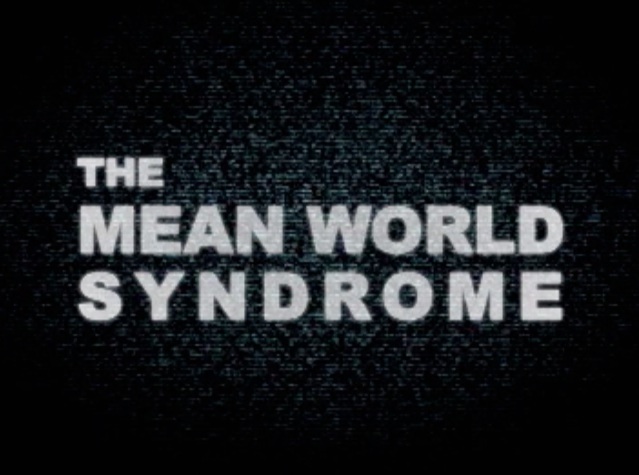
What kind of media messages are shaping our perception of the world? In the documentary, Mean World Syndrome, George Gerbner PhD, University of Pennsylvania spent his life studying how violence on television affects us. He found that over time, exposure to media violence had more complicating effects and looked at the effects of these images have on us over time. He noted that violence has become more prominent on mainstream television and during prime times. Not only this, but the type of violence that is shown has become more graphic and has increased, exposing us to more violent images many times during a day. In addition, the portrayal of violence has become so much a part of the normal viewing experience and that this is woven into our overall perception of the world and manifests itself in the form of fear and anger. Scenes of torture, extreme violence, the act of murder, and even humor surrounding violence have been more prominent in recent media. There is a casual tone that is conveyed through murder and torture scenes. When in the past, these scenes brought about a sense of shock and horror, they are now simply part of everyday television. I am not certain why we need such harsh displays of violence. Violence has always been embedded in our culture, but why the sudden increase and normalcy? As Gerbner said,
“Commercial media has eclipsed religion, art, and oral traditions as the great story telling engine of our time.”
There is more to our culture than violence. Fear, hate, and anger should not be the driving narrative of our time. Gerbner’s studies found that it is not simply the quantity of violent messages that we receive, but the quality. How all of these images add up to tell a story and the overall meaning has the greater effect on our society. Studies have shown that the amount of violence in media has caused an increase in violent behavior in children and is sowing seeds for various mental health disorders. In Gerbner’s studies, he debunked the Magic Bullet Theory, which is the assumption that the media content acts on us directly, leaving our minds changed. He said it is more cultivation – the violent media images help shape our minds over a period of time. The concept of “Mean World Syndrome” refers to heavy viewers of violence living in a meaner world. Seeing these images over a period of time cultivates an overall perception of mayhem, violence, disease, threats of war, visions of end times, and danger lurking everywhere. This creates the image of the world being an unsafe, vile, lawless, and mean which increases fear and anxiety.
The nightly news has contributed to the rhetoric of predators on the loose and fear of victimization. People think that violent crime is more prominent than it is, even though certain studies show that crime rates are decreasing. All this fear and anxiety and the “need to protect what is ours” mentality has led to an increase in concealed weapons carrying. Gun sales and businesses are booming across the country. Why is this happening? Most Americans get most of their news from television. Unfortunately, the news does not portray a true and varying depiction of certain ethnic groups. If you do not do your research and only listen to one narrative, you only ever get one side of the story. For example, Hispanics are often portrayed as being violent on TV. Latinas are always mentioned in the context of a single issue: illegal immigration. The media focuses on this topic and does not give attention to regular, decent, law-abiding citizens. Crime is lower in areas (mainly cities) where a lot of Latinas live. There is only one-sided representation, and the media is controlled by a small number of huge conglomerates. African Americans are often shown as either extraordinarily successful or to have committed crimes. This conveys the notion that African American Civil Rights have been addressed and there is no problem anymore. There is no representation for anyone in-between and when someone does “step out of line” media depicts them as ungrateful.
The culture of fear spreads to politics, raising the level of insecurity so that voting populations are more likely to demand protection. They are then more likely to want to hear politicians who convey that they are “tough on crime.” Even if crime rates are low, messages of fear seem to speak louder. We need to begin the work of cultivating a more just and broad-based media to reverse mixed messages of hate and fear in order to prevent us from becoming a mean, hardened, and uncompassionate society.
Question: How has limited media context helped shape your personal narrative? What assumptions are made about you or something important to you based on media messaging?
Work Cited:
MEAN WORLD SYNDROME, Google Drive. https://drive.google.com/file/d/1IuvlpzYmNYy0Wi4LmiCOV-fYqjN2YdtE/view?usp=sharing
 Mass Media and American Life