
By 1950, around 6 million people owned television sets, and by 1960 more than 60 million television sets had been sold (Understanding Media, Ch. 9.1) Color television hadn’t become available until the 1950’s. Television between the 1940’s and 1980’s was known as the Golden Age. At a time when the radio was still a popular medium for getting news and entertainment, newscasters and broadcasters were still treating the television like it was the radio. Broadcast times were lengthened from the standard 15 minute radio segment to a 30 minute which increased advertising costs. In the 1950’s the major networks tried to appeal to a family audience, ignoring social and political events portraying White middle-class family structures. There was always a morality story and the shows of that time gave a “feel good” impression that you can solve any problem in a half an hour. Many American families aspired to be like the families portrayed on these shows. By avoiding topics like racial segregation, war, and poverty, shows like Leave it to Beaver and Father Knows Best blanketed over the deprivation and injustices a good majority of Americans were experiencing.
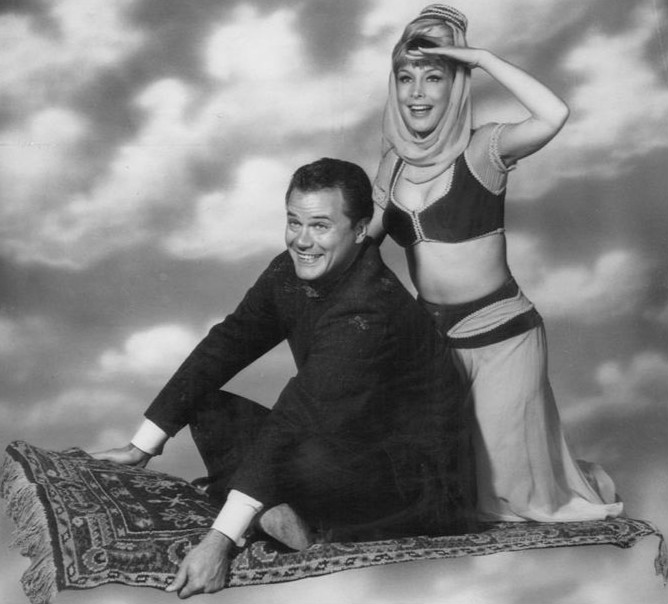
Walter Kronkite, a news journalist of the 1960’s brought hard-hitting news to the living rooms of Americans by reporting news events as they occurred, such as the JFK assassination. He built the trust of Americans and people relied on him to report the facts. This notion of stopping everything when the news came on or making certain that you were in front of the TV at 6:00pm because that’s when the news came on. At the time of the Vietnam War, news crews were capturing vivid images of the war. Some images reached the screen as well as the newspapers and magazines, such as images of children that were burned by napalm. Many Americans felt immense stress during these times and turned to television. In particular, and one of my favorite: fantasy television. Shows like I Dream of Jeannie and Bewitched provided a way to escape from the horrors that were happening in real life. These shows provided comedy and a way to escape from everyday realism. For awhile in the 1960’s, television was either hard-hitting news or escapism.
A popular series that premiered on October 2, 1959 was The Twilight Zone. It took the art of live tv and bridged several different genres like horror, drama, and sci-fi. The actors on Twilight Zone were doing live television during a time when radio was still a way to get news and televisions were just starting to gain popularity.
The documentary American Masters, is based on the career of Rod Serling, one of the main writers on the hit TV show. Live television is something that the actors on the set of Twilight Zone described as exciting and unpredictable. If you messed up, it was curtains for you! Their passion for the excitement of being on stage and the spontaneity of the moment was evident in their voices. You get the impression that they are well aware that they had been a part of something truly rare and great. It was these live performances and shows that paved the way for sitcoms and comedies that are so popular even today.
“I don’t have any background. We WERE the old days!!
-John Frankenheimer
Rod Serling passed away in 1975 at the young age of 50. Serling was a passionate writer who according to his wife, Carolyn tried to continuously live up to his success like he had something to prove. He wrote a lot of episodes based on morality lessons and he saw the human condition as something to think about. He often portrayed characters in realistic and simplistic manners, which helps his audience identify with the story lines. A lot of Serlings writings came from having PTSD and war memories. Serling wasn’t afraid to tackle political issues or highlight social injustices. He would face backlash from the network because the networks didn’t want to cover these issues like racism and war and they were concerned about the ratings. Other television shows of that time steered clear of such issues. He would have to defend his writing to CBS execs. Still, Serling felt the need to write about real life situations and found it frustrating and stifling that he wasn’t allowed to just ….write.
In the documentary, they recreated a Twilight Zone episode based around Rod Serling’s death. Rod had entered…..the TWILIGHT ZONE!
Question: Do you have a favorite show from the 1950’s and 1960’s? What is it?
Works Cited:
Understanding Media and Culture: An Introduction to Mass Communication, online text, M Libraries Publishing
Rod Serling: SUBMITTED FOR YOUR APPROVAL (GOOGLE DRIVE)
https://www.syfy.com/syfywire/the-first-episode-of-the-twilight-zone-premiered-in-1959
 Mass Media and American Life
Two of my favorite TV shows from the 1960s are Gilligan’s Island and the Andy Griffith Show. Both of them are fun with funny characters, and I have found memories of watching them with my siblings as we grew up. I think that even though a lot of the shows of the 1950s and 1960s did not tackle big, major issues in the world, they were fun, and they helped people escape, at leas for 30 minutes, the hardships of their own lives. I think you just need to find that balance between making something that people enjoy and want to watch and also making a point to help teach people something.
LikeLike