

The textbook, Understanding Media and Culture, in chapter 3 gives a history of how the books that we all know and love came to be, from the ancient beginnings of papyrus scrolls to the E-books downloaded on almost every tablet in the world. What is interesting however is that one specific movement that has changed millions of lives can be tracked along with the evolution of print. The Christianity movement has grown greatly since it began, and the written word of the Bible seems to be connected. The question is, did the spread of Christianity and the drive of Christians lead to the developments in print, or did the rise of printed materials lead to the spreading of Christianity? In addition, has the continual development of technology, and therefore the cheap introduction of any genre imaginable, taken away from various developments of religions and the desire of individuals to immerse themselves in religious texts?

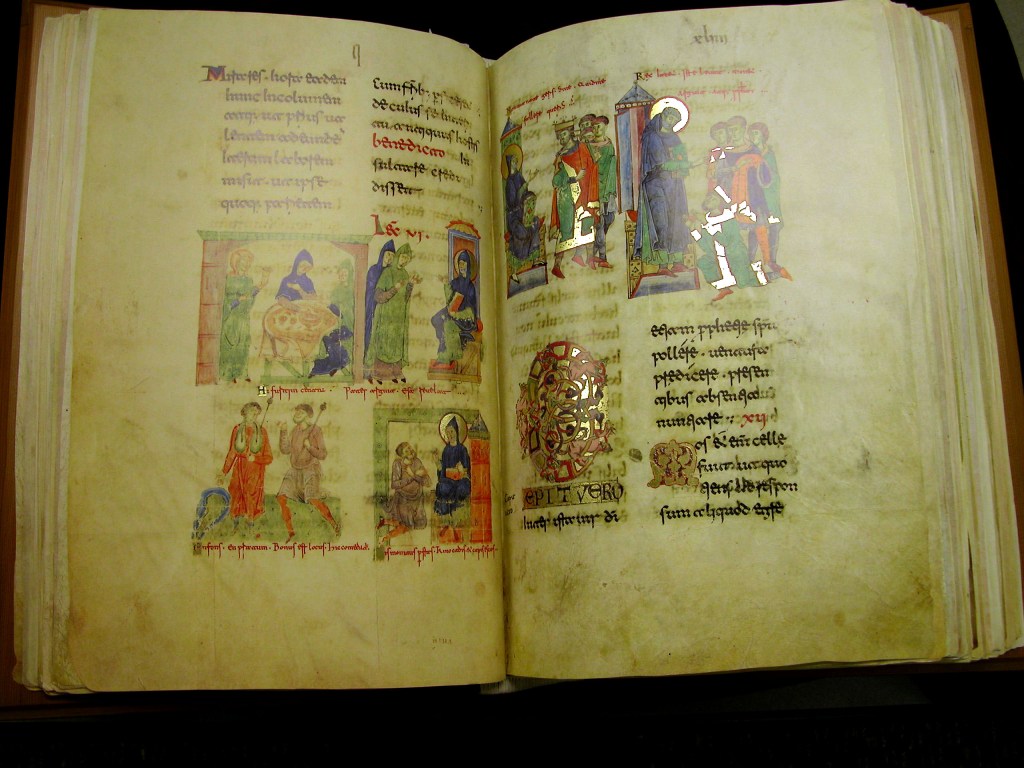
Understanding Media and Culture and the documentary, Out of Print, both spend a little time on the history of books, and both of them begin with talking about scrolls. Out of Print points out that people realized that to get to the end of a passage, one had to unroll the entire scroll. The specific scroll in the video was one that was about Christ’s life. To avoid this hassle came the idea of the codex, which was especially helpful in the spread of Christianity. “Between the 2nd and 4th centuries, the Romans began sewing folded sheets of papyrus or parchment together, and binding them between wooden covers…The codex was the preferred form for early Christian texts, and the spread of Christianity eventually brought about the dominance of the codex; by the 6th century CE, it had almost entirely replaced the scroll” (Understanding Media and Culture 84-85). Faith and religion was very important during that time—so much so that in the Middle Ages, monks laboriously copied by hand many classical texts—both religious and secular; they thought that studying even secular works could bring someone to God (Understanding Media and Culture 86).
From there technology developed with Gutenberg’s invention of the printing press. And what was one of the first things that he printed? The Bible (Understanding Media and Culture 86)! Professor Ugo Rozzo in the documentary, Out of Print, says about Gutenberg’s invention that, “It was not an invention of a cultural nature…we know that the printing press is responsible for the spread of the Reformation…” Though Gutenberg chose the Bible as his great work, the printing press was soon used to print all sorts of things. Books were so available that they lost value (Understanding Media and Culture 88).
The textbook and the documentary both go on to tell about the development of technology all the way to today, and therefore, the options that people have for reading are endless. Unlike it may have been in the Middle Ages, one does not only have religious texts to choose from anymore. I propose that perhaps people have stopped seeing the value of the Bible and other texts like it because they are produced like everything else and there are so many other things to read. There is no real cost anymore for reading materials; we do not have monks hand copying the most important texts anymore. Ultimately, it is nice to have the choice to read whatever you want to, but the question is because this is the case, are people not as interested in the spiritual realm as they used to be? Is the development of the technology of reading and books related to the decrease we see in the practicing of religions in America?
 Mass Media and American Life